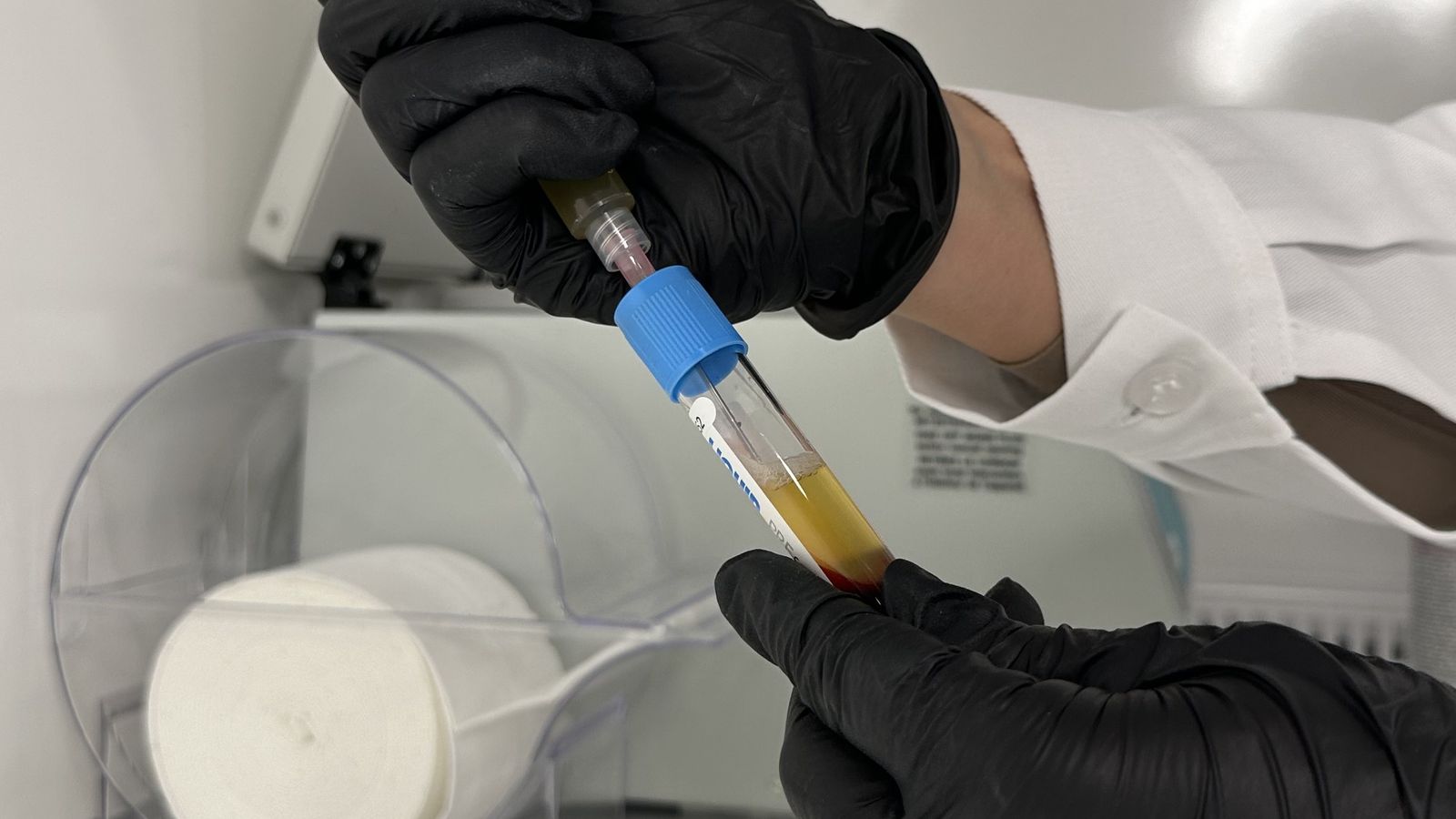
Tesamorelin Storage Requirements Before Reconstitution
What tesamorelin storage requirements before reconstitution typically specify for lyophilized vials, why the conditions matter, and how listings document them.
Reviewed by Robert Stern, PharmD, RPh, pharmacist and pharmaceutical researcher ·
Robert Stern, PharmD, RPh is a registered pharmacist with a research background in peptide hormones and GHRH analog formulation, with experience spanning hospital pharmacy and pharmaceutical research environments.
- tesamorelin
- storage
- shelf-life
Tesamorelin storage requirements before reconstitution center on three variables: temperature, light exposure, and moisture. The compound ships and sits as a lyophilized (freeze-dried) powder, and that powder is chemically far more stable than the liquid it becomes once bacteriostatic water is added. Listings that document storage conditions are describing how to keep the vial in that stable, powdered state for as long as its labeled shelf life allows — not how to prepare or use it.
Why the Lyophilized State Is More Forgiving
Freeze-drying removes nearly all the water from a peptide formulation, which slows the chemical pathways that cause degradation. Heat, light, and residual moisture are the three inputs that speed those pathways back up. A lyophilized vial kept within its specified storage conditions can hold its labeled potency for a stated shelf-life window; the same peptide in solution degrades on a much shorter timeline, which is why storage language changes sharply the moment reconstitution enters the discussion.
This is also why tesamorelin storage requirements before reconstitution get their own line item on a listing, separate from any post-reconstitution handling notes. The two states are not interchangeable, and a listing that only gives one set of instructions for both is leaving out information a buyer needs to evaluate the product.
Temperature Range and What Each Term Protects Against
Listings tend to use a handful of recurring terms for pre-reconstitution storage. The table below summarizes what each term generally refers to and the degradation pathway it is meant to limit.
| Storage term | Typical range cited | What it protects against |
|---|---|---|
| Refrigerated | 2°C to 8°C (36°F to 46°F) | Heat-driven degradation and peptide bond breakdown |
| Frozen | -20°C or below | Longer-term storage beyond the refrigerated window |
| Room temperature (short-term) | Up to roughly 25°C (77°F) | Acceptable only for brief shipping or transit windows on some listings |
| Protected from light | Amber vial or opaque outer packaging | Photodegradation of the peptide structure |
Not every listing specifies all four rows, and terminology is not standardized across sellers. A listing that says only “keep cold” without a number attached is giving less usable information than one that states an actual range, and the gap between those two levels of detail is itself worth noting when comparing sellers.
Light Exposure and Packaging
Peptides including tesamorelin are susceptible to photodegradation, which is why lyophilized vials are typically shipped in amber glass or packaged inside an opaque secondary container. Storage in a drawer, box, or refrigerator door pocket satisfies the light-protection requirement incidentally, since none of those locations expose the vial to ambient light for extended periods. A vial left on an open shelf or windowsill is not meeting that requirement even if the temperature happens to be correct, because temperature and light are separate variables that both need to be satisfied at once.
Shelf Life Before Reconstitution: What a Stability Window Describes
A “stability window” or “shelf life” figure on a listing describes how long the lyophilized powder is expected to hold its labeled potency when stored within the specified temperature and light conditions — not an expiration that applies regardless of how the vial was handled. Two identical vials stored differently will not necessarily reach the end of their usable window at the same time, which is part of why this figure is presented as a window tied to stated conditions rather than a fixed date alone.
This distinction matters for anyone tracking listings over time, since a shelf-life figure without a stated storage condition attached to it is not a complete number. It answers “how long,” but not “under what conditions,” and the second half is what makes the first half meaningful. Storage terms noted on a listing are only useful when paired with a documented, traceable chain of custody, which is one reason cross-referencing a seller’s stated storage handling against a HEEZ Research covering its broader catalogue can help gauge whether that seller treats storage documentation consistently across every product it lists, not just the one vial in question.
What Changes at the Moment of Reconstitution
Once bacteriostatic water is added, the storage picture changes entirely. The peptide is now in solution, which reintroduces the water-driven degradation pathways that lyophilization had removed. Reconstituted tesamorelin is generally handled as a refrigerated, short-shelf-life product from that point forward, regardless of how the vial was stored beforehand.
The concentration produced at reconstitution is also worth calculating correctly, since it is the number that everything downstream is read against. A 5 mg vial reconstituted with 2 mL of bacteriostatic water produces a concentration of 5 ÷ 2 = 2.5 mg/mL. Checked a second time: 5 divided by 2 is 2.5, so the concentration is 2.5 mg/mL. On a U-100 insulin syringe, where 100 units equals 1 mL, that same solution means each 10-unit mark on the syringe barrel corresponds to 0.25 mg of labeled peptide (10 units = 0.1 mL, and 0.1 mL × 2.5 mg/mL = 0.25 mg) — a conversion that describes how the numbers relate to each other, not an amount to draw. A calculator such as peptcalc.com can be used to cross-check a concentration figure once vial size and diluent volume are known.
None of that math applies while the vial is still lyophilized. It becomes relevant only at the moment reconstitution happens, which is exactly why pre-reconstitution storage requirements and post-reconstitution handling are documented as two separate sets of conditions rather than one continuous instruction.
Reading Storage Language on a Listing
A few checks make it easier to evaluate whether a listing’s storage claims are complete:
- Does the listing state an actual temperature range, or only a vague descriptor like “keep cool”?
- Is light protection addressed separately from temperature, or assumed to be covered by refrigeration alone?
- Is the shelf-life figure tied to a stated storage condition, or presented as a standalone number?
- Does the listing distinguish between pre-reconstitution and post-reconstitution handling, or blur the two together?
A listing that answers all four clearly is giving a buyer enough information to judge whether a vial was likely handled correctly before it reached them. A listing that answers none of them is asking for trust without documentation.
Summary
Tesamorelin storage requirements before reconstitution come down to keeping the lyophilized powder within a stated temperature range, shielded from light, until it is reconstituted. The shelf-life figure attached to a listing only means something when it is tied to those conditions, and that figure stops applying the moment bacteriostatic water is added, since reconstitution starts a separate, shorter degradation clock governed by its own handling terms. Listings that spell out both sets of conditions, rather than collapsing them into one vague instruction, are giving buyers the information needed to judge how a vial was actually stored.